Leave Your Message
Choosing Degradable Dog Poop Bags sounds simple until the first bag leaks beside your shoes. Material labels, disposal systems, and real-world durability all matter. A responsible purchase should protect your hands, your garden path, and the wider environment.
Steve Mojo, former executive director of the Biodegradable Products Institute, has emphasized, “Compostable products need a specific composting environment.” That warning deserves attention. A bag may claim degradability, yet still require commercial composting conditions. Check recognized standards, such as ASTM D6400 or EN 13432, when available. Also, verify whether your local facility accepts pet-waste bags. Many facilities do not.
This guide presents seven practical tips for selecting Degradable Dog Poop Bags. We will examine certification language, thickness, seal strength, roll design, storage, and disposal instructions. A useful bag should open quickly during a rainy walk. It should hold waste without stretching or splitting. Dark colors can hide waste, but they may also hide weak seams. That detail is easy to miss.
I have found that “eco-friendly” claims often sound more impressive than their evidence. That is uncomfortable, but worth admitting. Buyers should compare package details, manufacturer transparency, and independent certification. Price matters too, though the cheapest roll may become expensive after one messy failure. Good choices combine dependable performance with realistic environmental expectations. No bag solves the waste problem alone. Better decisions begin with careful reading and honest testing.
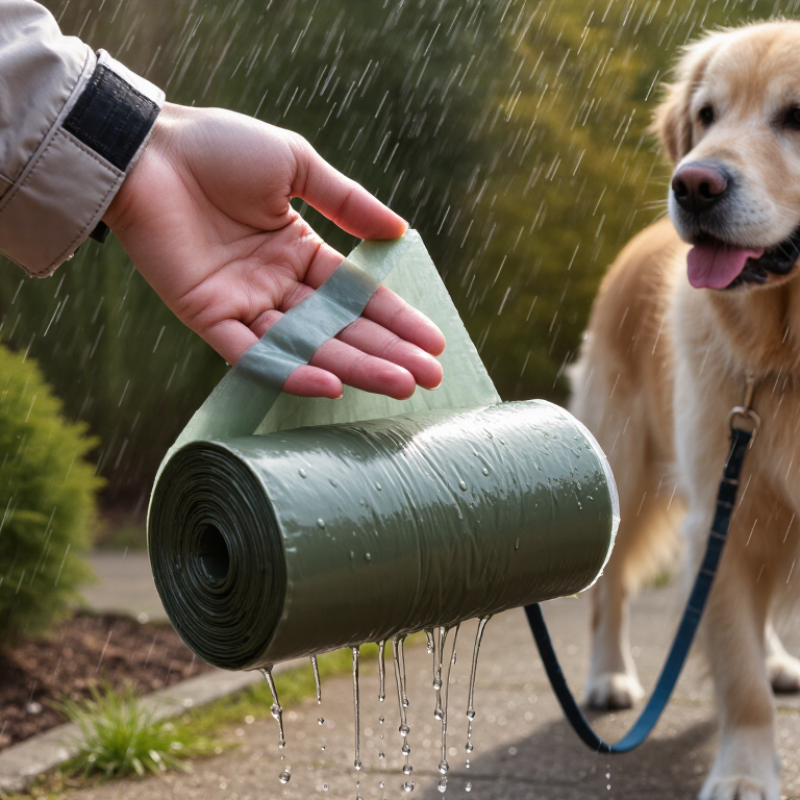
Choosing degradable dog poop bags starts with understanding the label. “Degradable” is not a complete environmental claim. Compostable bags can break down into water, carbon dioxide, and biomass under specific conditions. Many require commercial composting facilities. Biodegradable bags rely on microorganisms, but the breakdown time and setting may be unclear. Oxo-degradable plastic uses additives that trigger oxidation. It may fragment into smaller pieces rather than fully disappear. That distinction matters.
Tip one: Read the entire label, not only “eco-friendly.” Tip two: Check whether the bag needs industrial composting. Tip three: Look for recognized compostability certification. Tip four: Avoid assuming biodegradable means home-compostable. It often does not. Tip five: Ask how the material behaves in landfills, where oxygen and microbes may be limited. Tip six: Test one bag with a full, carefully tied load. Thin plastic can fail at the worst moment. Tip seven: Confirm local waste guidance before choosing compostable packaging.
A practical test helps. Fill a bag with water, tie it, and hold it over a sink for several minutes. This checks weak seams before a walk. Also inspect the roll. Torn perforations create small failures quickly. Some packaging uses confident language without explaining conditions. That should make you pause. I still think “degradable” sounds more precise than it is. When disposal instructions are missing, choose the clearest claim, not the most attractive promise.
“Degradable” is a broad marketing term, not a complete performance description. Check the material claim, testing standard, disposal conditions, and local waste rules before buying dog poop bags.
| Material or Claim | What It Means | Typical Disposal Condition | Relevant Evidence or Standard | Key Buying Caution |
|---|---|---|---|---|
| Compostable | Designed to break down into carbon dioxide, water, inorganic compounds, and biomass under specified composting conditions without leaving prohibited toxic residues. | Usually requires a commercial or industrial composting facility. Home compostability is a separate claim and should be stated explicitly. | Look for certification or conformity with standards such as ASTM D6400 or EN 13432, together with clear disposal instructions. | A compostable bag is not automatically suitable for backyard composting, and many facilities do not accept pet waste. |
| Biodegradable | Can be broken down by microorganisms, but the claim alone may not specify how quickly, under which conditions, or whether harmful residues remain. | Depends on the material, temperature, moisture, oxygen level, and microbial activity. Landfill conditions may not support meaningful biodegradation. | Prefer a defined test method, time frame, and independent certification rather than the word “biodegradable” alone. | Do not assume that a biodegradable bag will break down quickly in a landfill or in the natural environment. |
| Oxo-degradable | Contains additives intended to accelerate oxidation and fragmentation of conventional plastic when exposed to heat, light, or oxygen. | Fragmentation may occur in certain environmental conditions, but fragmentation is not the same as complete biodegradation. | Check whether the product is accepted under current local regulations and waste-management policies. | Oxo-degradable plastics are widely criticized for potential microplastic formation and can interfere with recycling or composting streams. |
| Conventional plastic | Commonly made from polyethylene or similar fossil-fuel-based polymers and generally designed for durability rather than biological breakdown. | Normally disposed of as residual waste. It is not suitable for composting. | Material disclosure and accurate disposal labeling are more useful than vague environmental wording. | A thinner bag may use less material, but it must still be strong enough to prevent leakage and tearing. |
| No. | Buying Tip | What to Check | Why It Matters |
|---|---|---|---|
| 1 | Define the claim | Identify whether the bag is labeled compostable, biodegradable, oxo-degradable, recycled-content, or simply degradable. | These terms describe different materials and performance expectations. A general “eco-friendly” label is not enough to predict end-of-life behavior. |
| 2 | Match the bag to disposal access | Confirm whether your local authority or composting facility accepts pet waste and certified compostable bags. | Disposal infrastructure determines whether a claimed environmental benefit can actually be realized. |
| 3 | Look for recognized certification | For compostable products, look for a recognized certification mark and a standard such as ASTM D6400 or EN 13432. | Independent testing provides more reliable evidence than an unsupported claim printed on packaging. |
| 4 | Check home-composting instructions | Buy a product specifically labeled for home composting only if you have suitable conditions and the product provides a verifiable home-composting claim. | Industrial composting uses controlled heat, moisture, oxygen, and processing conditions that ordinary backyard piles may not reach. |
| 5 | Test strength and leak resistance | Review bag dimensions, thickness or gauge information when available, seam quality, stretch, and ease of opening. | An environmentally preferable bag still needs to contain waste safely and avoid accidental exposure or double-bagging. |
| 6 | Avoid vague oxo-degradable claims | Be cautious when a product promises to “disappear” through oxidation without explaining complete biodegradation, testing, or disposal compatibility. | Breaking into smaller plastic fragments does not demonstrate complete biological breakdown and may create additional waste-management concerns. |
| 7 | Choose practical packaging | Consider roll size, core material, dispenser compatibility, scent additives, perforation quality, and the amount of unnecessary packaging. | Convenient packaging can reduce accidental waste and make consistent responsible disposal easier during daily walks. |
Important: Dog feces may contain pathogens and parasites. Unless local regulations and a suitable facility specifically allow it, do not place pet waste or pet-waste bags in home compost used for growing food.